Case Study · Electrical Contractor · Tampa, Florida

Books sitting nearly $40K off the bank in year one, rebuilt into a measurable 57% margin

Overtime Electric started trading in October 2025 on the stock QuickBooks chart of accounts. Eight months later the file reported negative revenue, negative total assets, and a checking balance that had drifted far from what the bank actually held. We built the books a contractor needs and brought every number back to reality.

ClientOvertime Electric
TradeNew construction, remodels, service upgrades
LocationTampa Bay, Florida
EngagementSetup & cleanup → monthly bookkeeping
Overtime Electric
$39.9KBank gap closed
57%Gross margin
102Accounts built
Rolian, owner of Overtime Electric
Rolian · Owner Overtime Electric · Tampa, FL
$39.9K
Bank-to-book gap closed
QuickBooks reported −$27K in the checking account while the bank itself held ~$13K.
57%
Gross margin, now measurable
Gross profit had been running negative, so there was no margin to read at all.
102
Accounts in a construction chart
Replacing a stock QuickBooks list in which just 11 accounts carried every transaction.
~$186K
Revenue, correctly recognized
The same file had been reporting total income of negative $17K.
Where the books stood Before After
Checking balance in QuickBooks −$27K Tied to the bank
Total assets on the balance sheet −$23K ~$36K
Gross margin Not measurable 57%
Cost accounts for job costs 1 lump Materials, labor, subs
Vehicle and its loan on the books Neither Both, amortized
The Client

A new company on default settings

Overtime Electric is an electrical contractor working across Tampa Bay on new construction, remodels and service upgrades. The company opened for business in October 2025, and like most new contractors it started on whatever QuickBooks offered out of the box. The work came in fast. The bookkeeping never caught up, and the default chart of accounts had no idea it was looking at a construction business.

What they do
New construction Remodels Service upgrades
Electrical contractor · Tampa Bay, Florida · trading since October 2025
Before

Every statement disagreed with reality

This was not a case of a few miscoded transactions. Revenue was reported as a negative number, total assets were reported as a negative number, and a financed work van and its loan were missing from the balance sheet entirely.
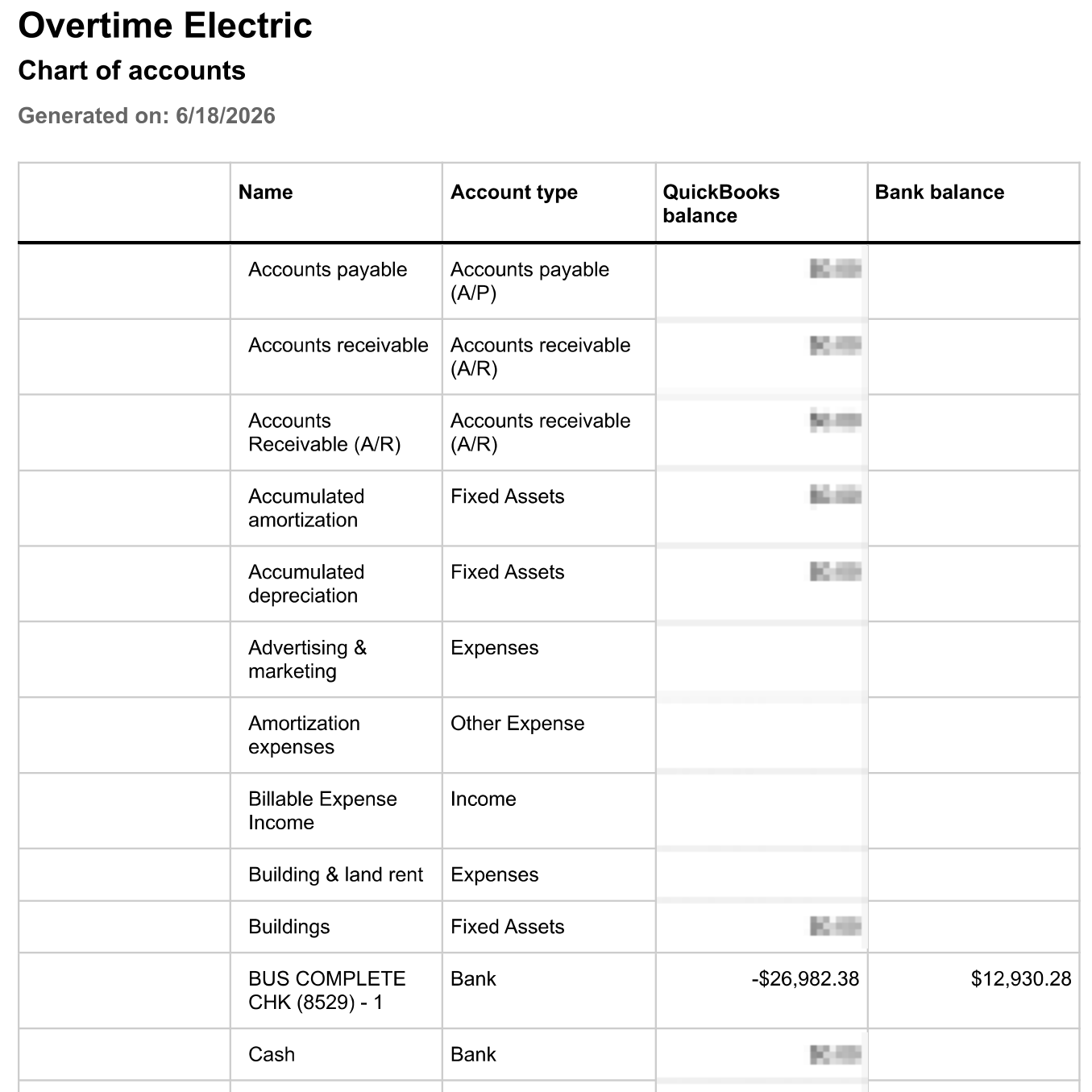
Overtime Electric — Chart of accounts (before cleanup)
Overtime Electric chart of accounts report before cleanup, showing the checking account at negative ~$27K in QuickBooks against a real bank balance of ~$13K; all other balances blurred for privacy.
Before QuickBooks' own report, side by side: the QuickBooks balance column said −$27K while the Bank balance column right beside it said ~$13K. A ~$40K disagreement, on the account the whole business runs through.
Straight from the client's QuickBooks. The company name is shown to confirm whose books these are; all other figures are deliberately blurred.

The books were $39.9K off the bank

The checking account showed −$27K in QuickBooks against ~$13K at the bank, because months of activity had never been entered.

Revenue reported as negative

Service income sat at −$18K and was split against a "Billable Expense Income" account, dragging total income to −$17K.

Negative total assets

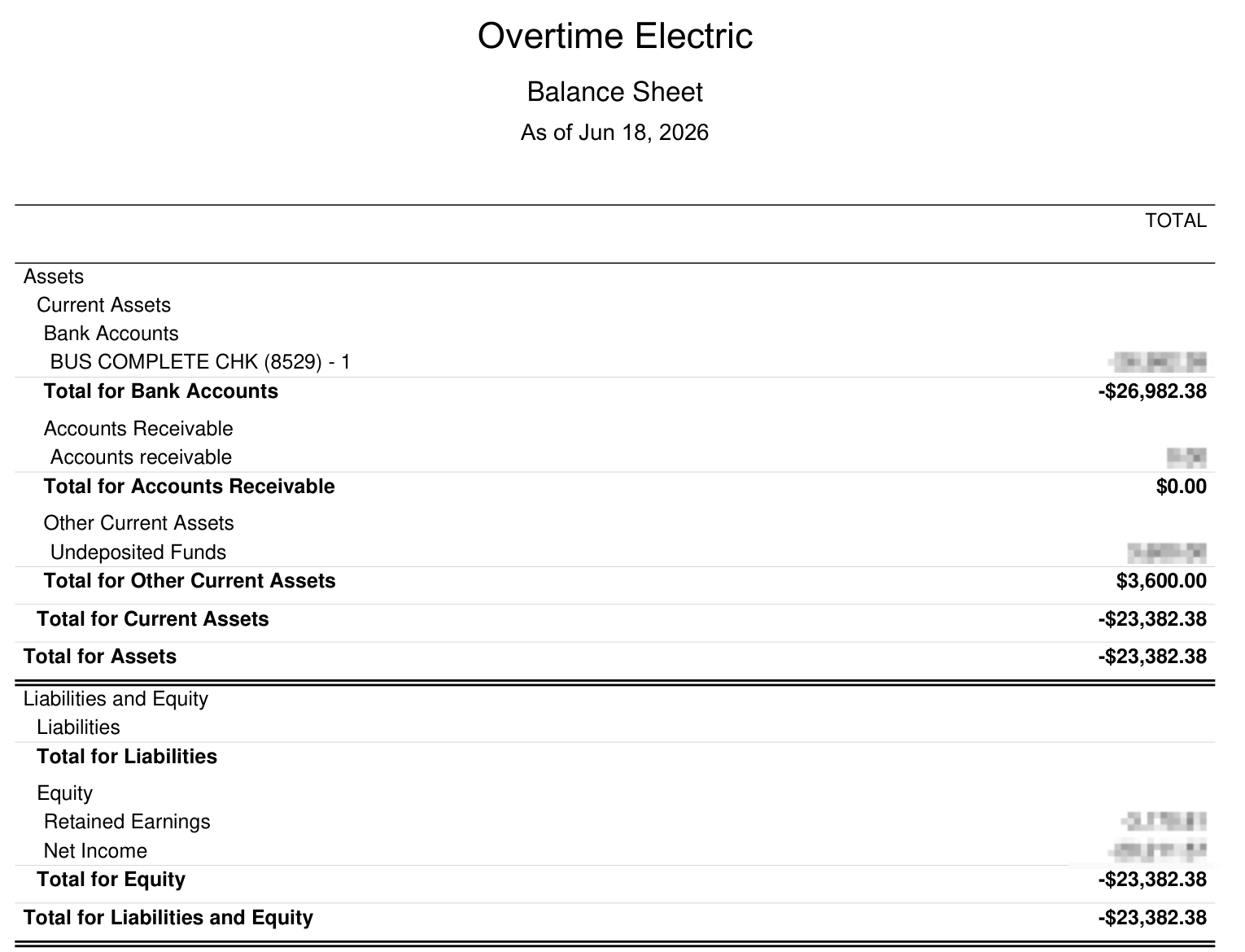
The balance sheet reported total assets of −$23K, with a Liabilities section that contained nothing at all.

One cost account for a whole trade

Cost of goods sold held a single under-$1,000 "Direct supplies & materials" line. No labor, no subcontractors, no job site costs.

Personal and business money mixed

Roughly ~$42K of the owner's personal spending was sitting inside the business books, so profitability could not be read.

Whole accounts simply missing

Two business credit cards were never connected, a financed van and its loan were never recorded, and live "Uncategorized" buckets absorbed the rest.
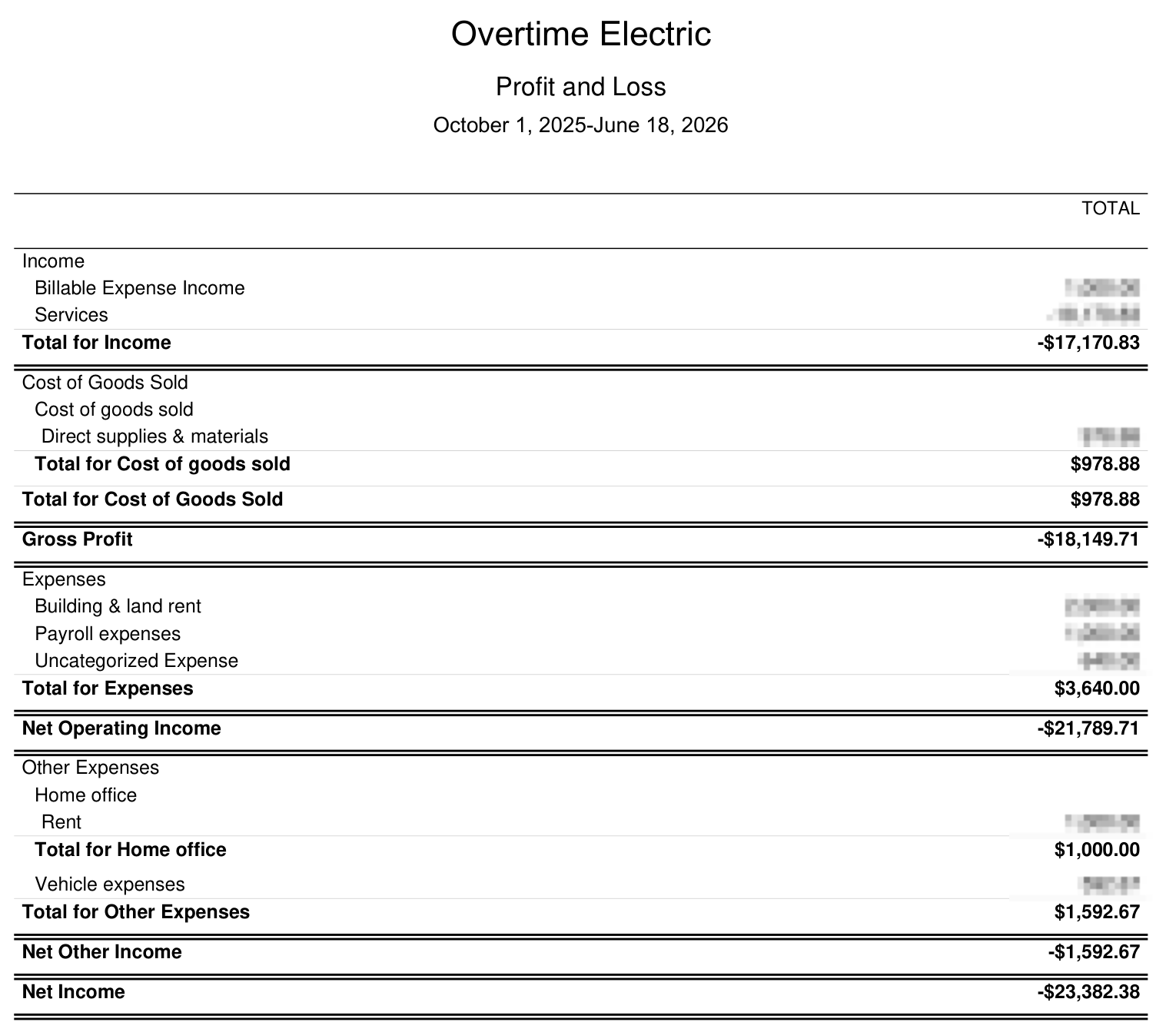
Profit & Loss (before cleanup) — Overtime Electric
Overtime Electric profit and loss before cleanup, showing negative service income and a negative gross profit; expense detail amounts blurred for privacy.
Before Income was recorded so inconsistently that the whole section netted out backwards: Total for Income lands at −$17K. Against under $1,000 of cost of goods sold, that produces a negative gross profit, which is another way of saying there was no margin to measure. (Individual account amounts are blurred; only the roll-up totals are shown.)
Straight from the client's QuickBooks. The company name is shown to confirm whose books these are; all other figures are deliberately blurred.
Balance Sheet (before cleanup) — Overtime Electric
Overtime Electric balance sheet before cleanup, showing a negative bank balance and negative total assets with an empty liabilities section; equity detail blurred for privacy.
Before The balance sheet reported total assets of −$23K. Note what is not there: Total for Liabilities is blank, because the van loan had never been entered, and there are no fixed assets, because the van itself had never been entered either.
Straight from the client's QuickBooks. The company name is shown to confirm whose books these are; all other figures are deliberately blurred.
What We Did

Built the foundation, then caught the file up to it

A cleanup on top of a generic chart of accounts just produces tidier nonsense. We designed the accounts an electrical contractor actually needs first, had the owner approve them, and then posted the history into that structure.

1

Designed a construction chart of accounts

A numbered 1000 to 7100 structure built for an electrical contractor: work in progress, retention receivable, underbillings, materials, direct labor, subcontractors and job site costs. The owner reviewed and approved it before anything was posted.

102 accounts
2

Connected the two business credit cards

Neither card had ever been linked to QuickBooks, so a large slice of business spending existed nowhere in the books. We connected both and imported the outstanding activity.

300+ transactions
3

Posted the historical backlog

Reviewed, categorised and posted every outstanding bank and credit card transaction, including activity going back to 2025 that had never been recorded at all.

600+ transactions
4

Corrected revenue and consolidated it

Cleared the negative service income balance, retired the inconsistent postings, and consolidated everything into 4010 Contract Revenue-Electricity so revenue reads as one reliable figure.

5

Built a real cost of goods sold

Separated materials and supplies, small tools, subcontractor labor and job site expenses into their own accounts, which is what makes a gross margin mean anything on a job.

6

Organised the operating expenses

Created grouped accounts for administration, facilities, professional services, technology and software, insurance, vehicle costs, bank fees, licences and repairs, then coded every transaction into the right one. Nothing was left in Uncategorized Expense.

7

Separated personal from business

Went through the activity transaction by transaction, identified the owner's personal spending, and moved it out of the expenses and into owner's drawings where it belongs.

~$42K reclassified
8

Recorded the van and its loan

Capitalised the financed vehicle at ~$22.8K, recorded the matching loan, and built a full amortisation schedule so every payment splits correctly between principal and interest.

9

Recognised depreciation and interest

Neither had ever been recorded, because the asset and the loan did not exist in the file. We booked ~$3.8K of accumulated depreciation and ~$1.1K of vehicle loan interest.

10

Reconciled and rebuilt the balance sheet

Reconciled the bank to the statements, cleared the leftover balances, and reviewed every balance sheet account until the statement represented the company's real financial position.

Now monthly
After

Revenue that reads as revenue

Instead of a negative "Services" balance fighting a "Billable Expense Income" account, the first half of 2026 rolls up to a single clean contract revenue line of ~$186K.
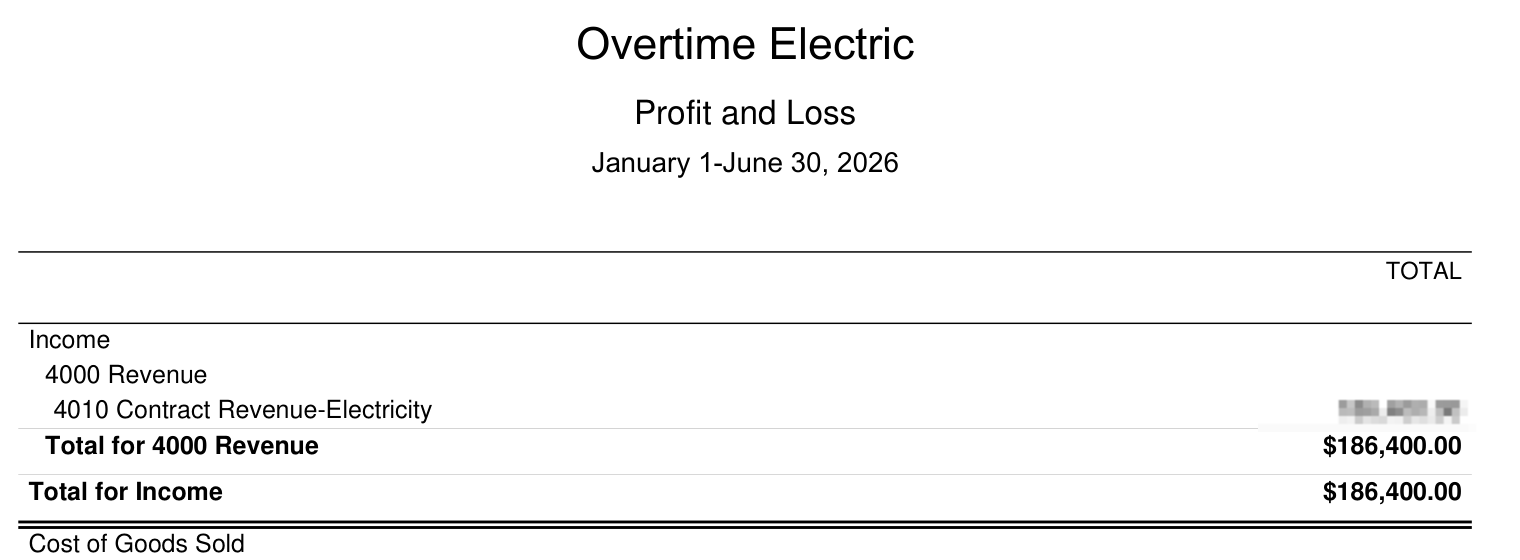
Overtime Electric — Profit & Loss (after cleanup)
Overtime Electric profit and loss after cleanup showing total income of ~$186K under 4010 Contract Revenue-Electricity; the detail line blurred for privacy.
Highlighted The rebuilt income section. Revenue now sits under 4010 Contract Revenue-Electricity inside a numbered 4000 Revenue group, rolling up to ~$186K for January to June 2026.
Straight from the client's QuickBooks. The company name is shown to confirm whose books these are; all other figures are deliberately blurred.

What had never made it into the books

The "before" figures are not a smaller version of the same business. They are what happens when most of the year was never entered and the accounts to hold it did not exist.

Cost of Goods Sold
Before$979
After~$80K
Operating Expenses
Before~$3.6K
After~$67K
Fixed Assets Recorded
Before$0
After~$22.8K
Liabilities Recorded
Before$0
After~$19.8K

"Before" figures are what the original file reported on 18 June 2026. "After" figures cover January to June 2026 on the rebuilt file.

After · Job costing

Cost of revenue, split the way a job is

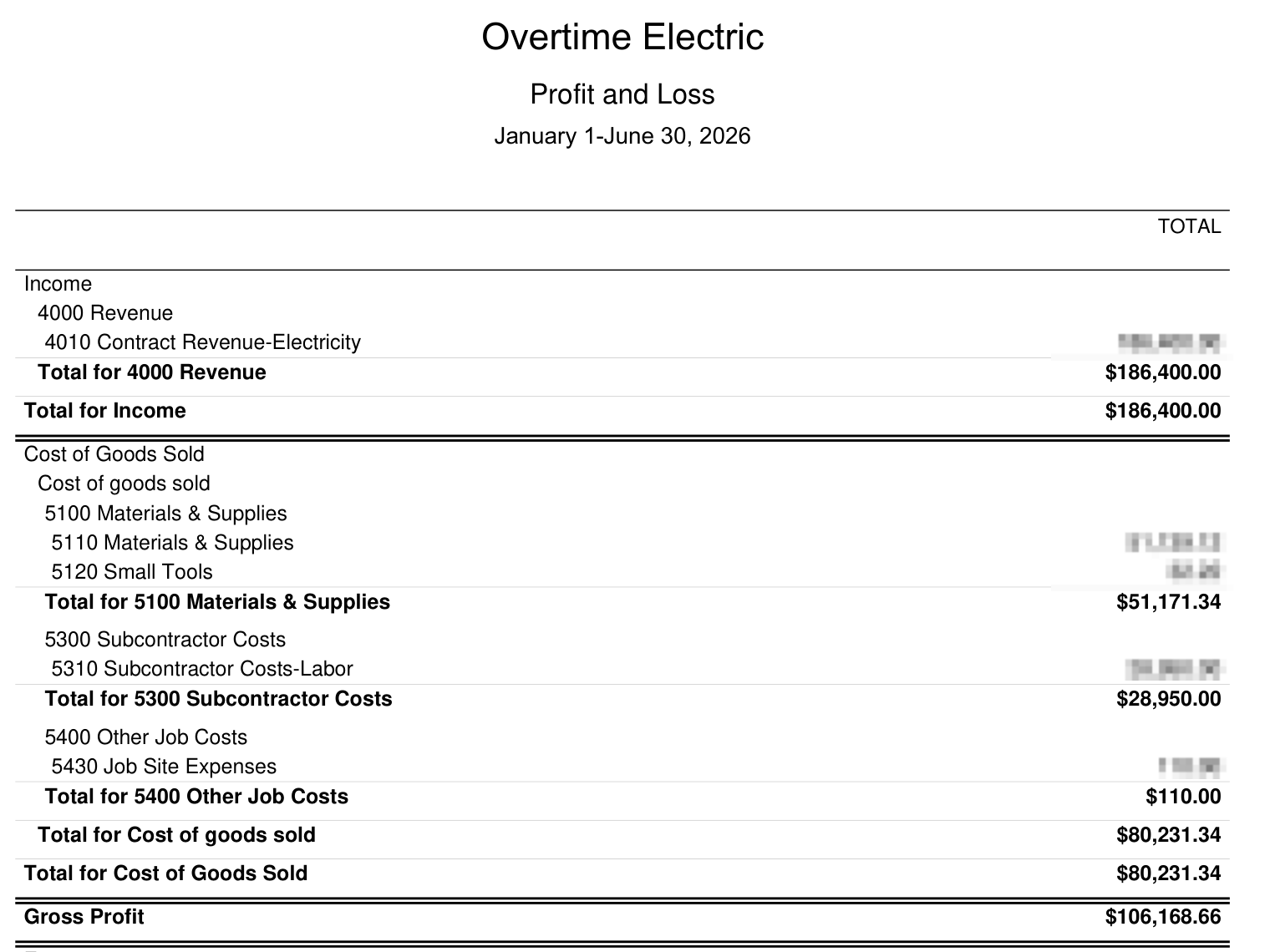
An electrical contractor's money goes out in three directions: materials off the shelf, subcontracted labor, and whatever the job site itself costs. Those are now three separate accounts instead of one, which is the only reason a 57% gross margin can be calculated at all.

5100 Materials & Supplies · incl. small tools63.8%
5300 Subcontractor Costs · labor36.1%
5400 Other Job Costs · job site expenses0.1%

Share of ~$80K total cost of goods sold, January to June 2026.
Overtime Electric — Cost of Goods Sold detail (after cleanup)
Overtime Electric cost of goods sold after cleanup, showing separate numbered accounts for materials, subcontractor costs and other job costs, and a gross profit of ~$106K.
Highlighted Cost of goods sold now breaks into 5100 Materials & Supplies, 5300 Subcontractor Costs and 5400 Other Job Costs, totalling ~$80K against ~$186K of revenue. That is what turns the bottom of this exhibit, ~$106K of gross profit, into a readable 57% margin.
Straight from the client's QuickBooks. The company name is shown to confirm whose books these are; all other figures are deliberately blurred.
After · Chart of accounts

An electrical contractor's chart of accounts

The old file was not missing accounts so much as missing the right ones. QuickBooks had supplied a long alphabetical list of generic accounts, of which only 11 were carrying any activity, and not one of them described construction work.
Before

QuickBooks default, alphabetical

  • No account numbers, sorted A to Z
  • "Uncategorized Expense", "Uncategorized Income", "Uncategorized Income-1"
  • Personal accounts live: home office, mortgage interest, property taxes
  • Revenue as "Services" and "Billable Expense Income"
  • No WIP, no retainage, no job costing
After

Numbered, built for the trade

  • 102 accounts numbered 1000 to 7100, grouped by type
  • 1220 Retention Receivable · 1310 Underbillings · 1300 WIP
  • 5100 Materials · 5200 Direct Labor · 5300 Subs · 5400 Job Costs
  • 6100 to 6600 operating expenses in six grouped families
  • 3400 Owner's Drawings for personal spend · accrual basis
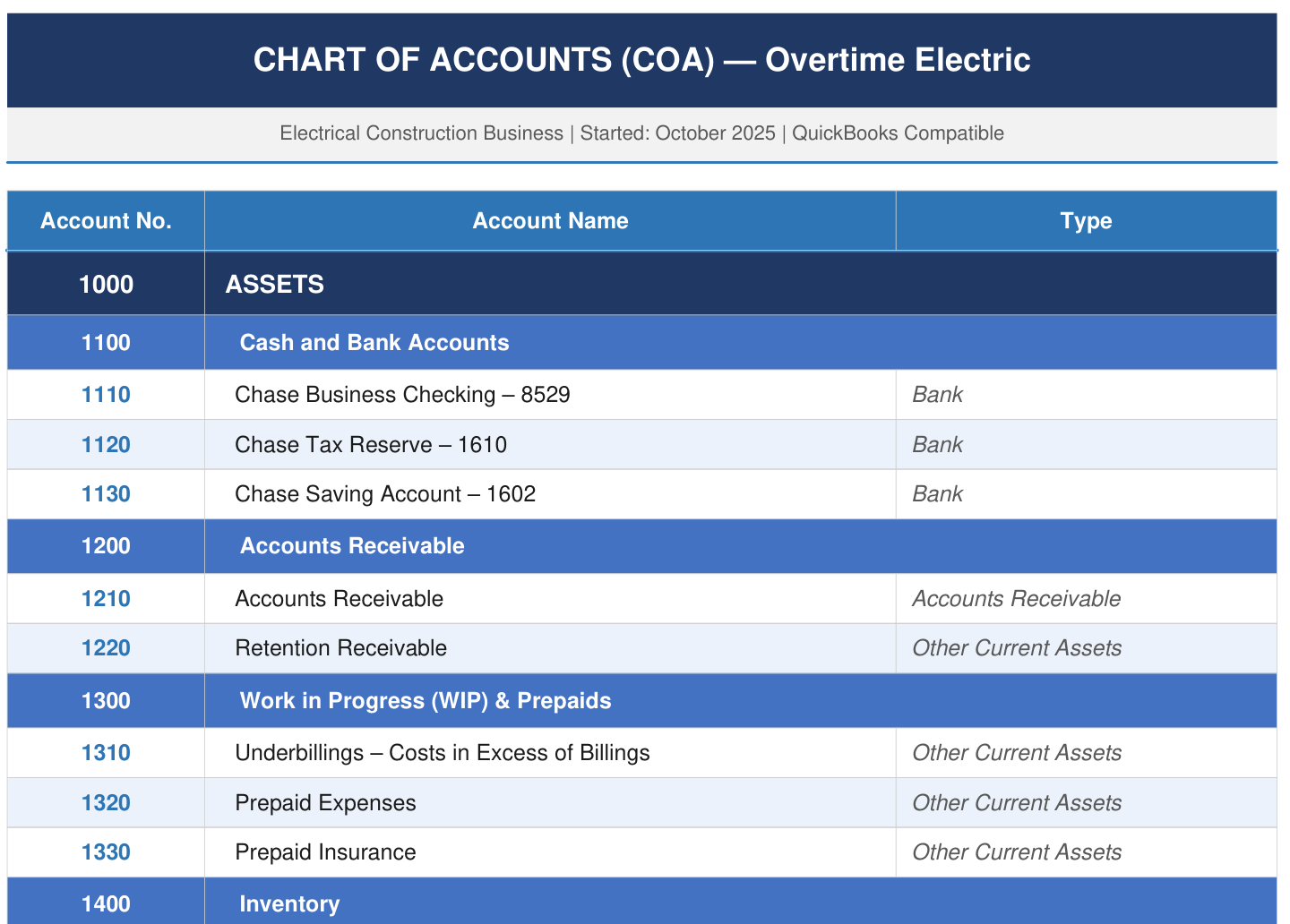
Overtime Electric — Chart of accounts (designed & client-approved)
The construction chart of accounts FinTruction designed for Overtime Electric, showing numbered accounts including retention receivable, work in progress and underbillings.
Highlighted The chart of accounts we designed and the owner signed off on. The circled block is the part a generic chart never has: 1220 Retention Receivable for money held back on contracts, and a 1300 Work in Progress group carrying 1310 Underbillings, costs in excess of billings.
This is the chart of accounts document FinTruction designed for Overtime Electric and the owner approved. It is our own deliverable and carries no transaction data or balances.
After · Balance sheet

A balance sheet with the whole business on it

Total assets moved from a reported −$23K to ~$36K, not because the company suddenly grew, but because the things it already owned and already owed were finally written down.

The van, capitalised

A financed work vehicle worth ~$22.8K had never appeared on the balance sheet. It is now recorded under 1520 Vehicles.

The loan, amortised

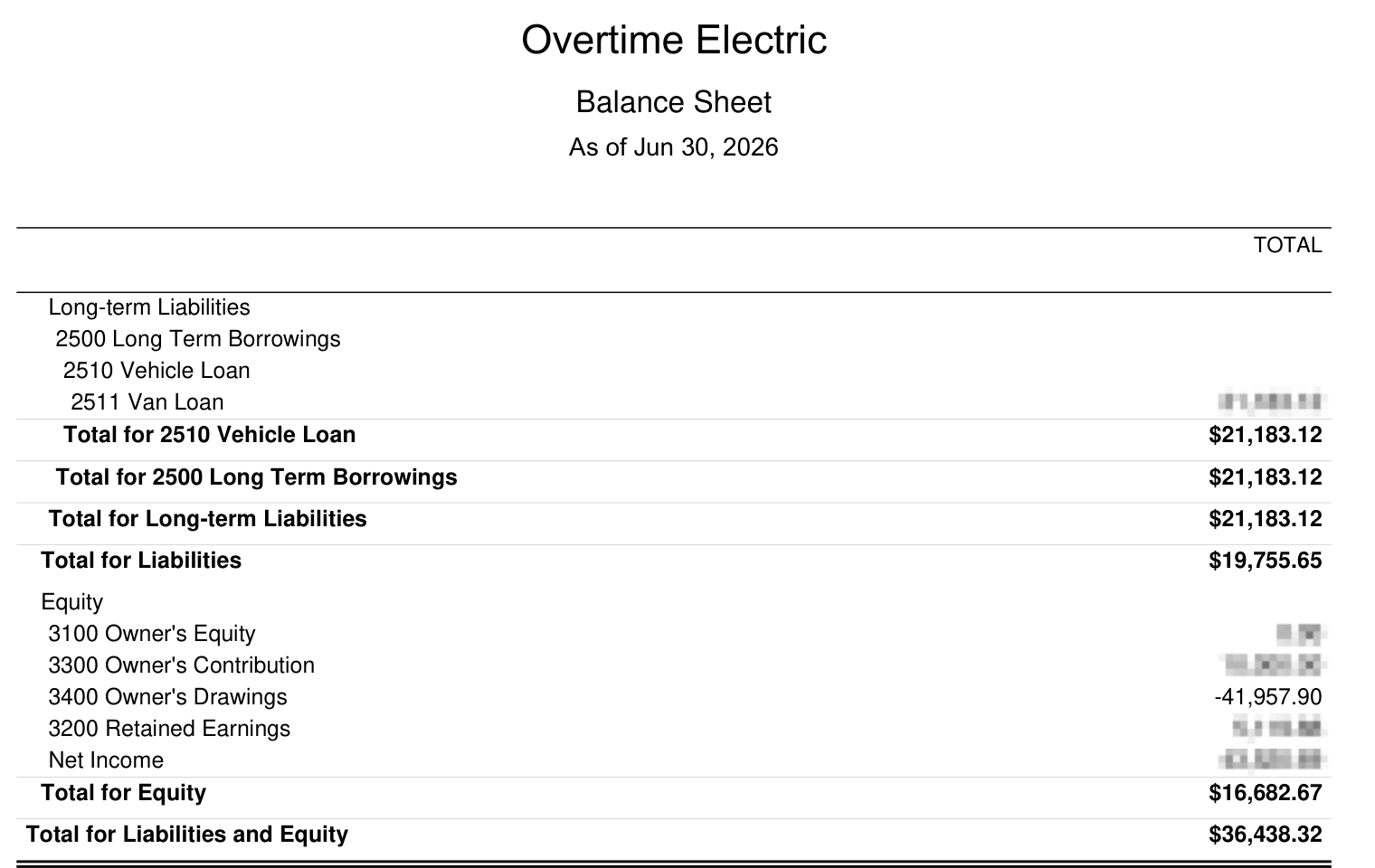
The matching liability was recorded and put on a schedule, paying down from ~$22.8K to ~$21.2K by 30 June 2026.

Depreciation recognised

With the asset on the books, ~$3.8K of accumulated depreciation could be calculated and recorded for the first time.

Interest split from principal

~$1.1K of vehicle loan interest is now expensed properly instead of every payment being treated as a cost.

Both credit cards live

The two business cards are connected and carrying their real balances, so spending is captured as it happens and reconciliation is routine.

Personal spend, separated

~$42K of the owner's personal spending now sits in 3400 Owner's Drawings, out of the expenses, so profit is real profit.
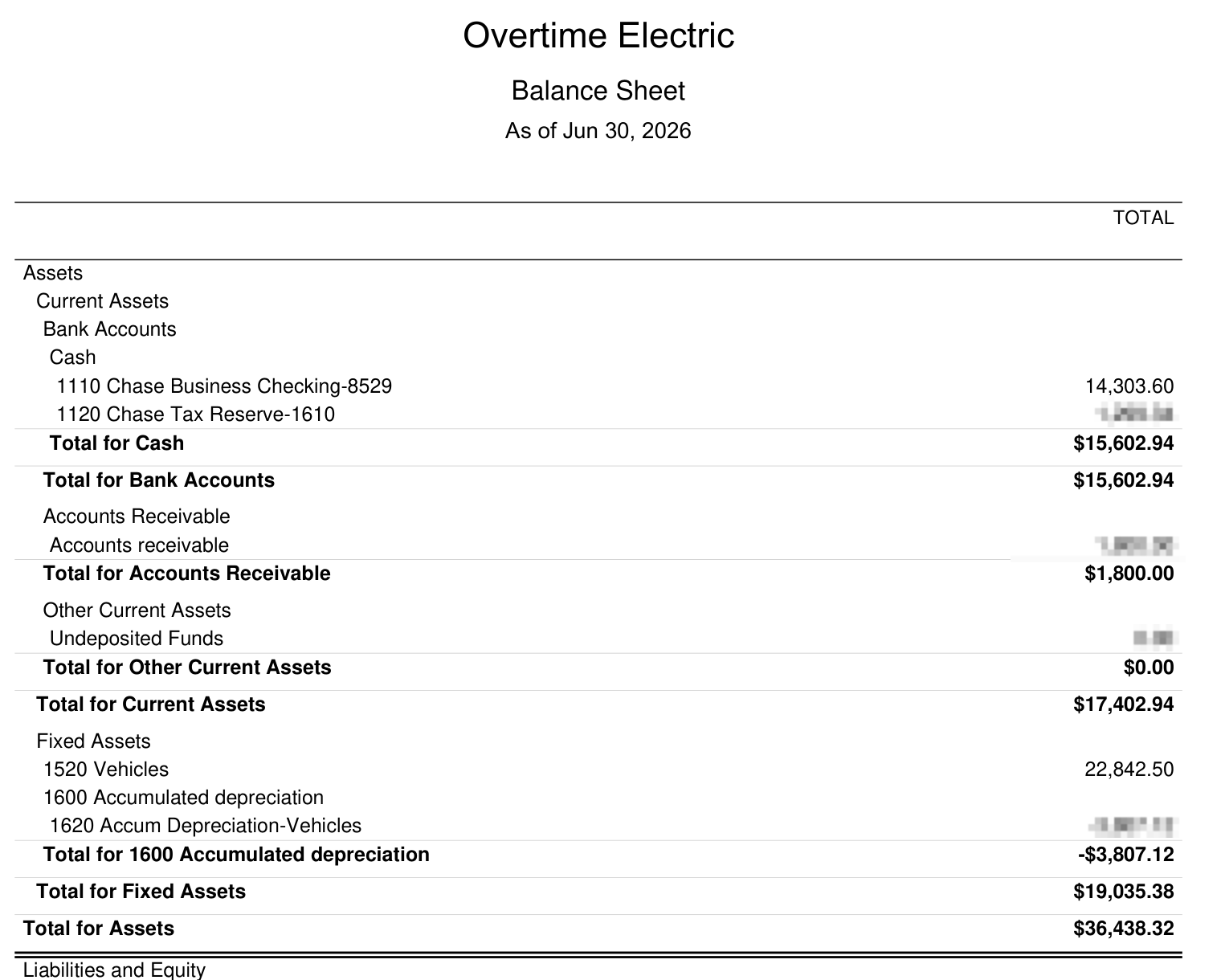
Overtime Electric — Balance Sheet (after cleanup)
Overtime Electric balance sheet after cleanup, showing a fixed assets section with the vehicle and accumulated depreciation, and total assets of ~$36K.
Highlighted The section that did not exist before: a Fixed Assets block carrying 1520 Vehicles at ~$22.8K net of ~$3.8K of accumulated depreciation. Total assets now come out at ~$36K, against a reconciled checking balance of ~$14.3K.
Straight from the client's QuickBooks. The company name is shown to confirm whose books these are; all other figures are deliberately blurred.
Overtime Electric — Balance Sheet, liabilities & equity (after cleanup)
Overtime Electric balance sheet after cleanup, showing the vehicle loan under long term borrowings and personal spending reclassified to owner drawings; other equity lines blurred for privacy.
Highlighted Page two of the same statement. 2511 Van Loan sits under long term borrowings at ~$21.2K, paid down on a proper amortisation schedule, and 3400 Owner's Drawings holds the −$42K of personal spending that used to be buried in the expenses.
Straight from the client's QuickBooks. The company name is shown to confirm whose books these are; all other figures are deliberately blurred.
How it runs now

Set up once, kept current since

The advantage of fixing this in year one is that there is no second backlog to clear. The structure is built, the feeds are connected, and the books stay level with the work.

What we handle on an ongoing basis

Every weekBank and credit card activity is reviewed and coded into the new accounts, so nothing accumulates in a queue waiting to become a cleanup project.
Every monthAccounts are reconciled to the statements, the loan schedule and depreciation are posted, and the owner gets financials that show what the margin actually did.
Kept separatePersonal spending is identified and routed to owner's drawings as it happens, rather than being untangled at year end.
Sneak peek from one of our client calls A FinTruction monthly review video call with a construction client
One of our monthly review calls with a client, in action.
600+
Historical transactions posted
~$186K
Revenue correctly recognized
57%
Gross margin, from non-measurable
102
Accounts built for the trade
In Their Words

What the owner had to say

Started the company in October 2025 and the work took off way faster than I planned for. I was just using whatever QuickBooks gave me. Never really thought about it.

By this summer my books were showing a bank balance nowhere close to what I actually had, my revenue was somehow a negative number, and my work van was not even on there. I had no idea if I was making money on any of it.

FinTruction set the accounts up properly first, then went back and cleaned up everything I never entered. Found the van, found the loan, got my personal spending out of the business. Now I can look at my margin and actually believe it.

Rolian, owner of Overtime Electric
Rolian
Owner, Overtime Electric · Tampa, FL

Just started a contracting business?

The stock QuickBooks chart of accounts cannot tell you whether a job made money, and every month you run on it is another month to clean up later. We build the accounts a contractor needs, connect the feeds, and keep the books level with the work. Free consultation, zero commitment.